
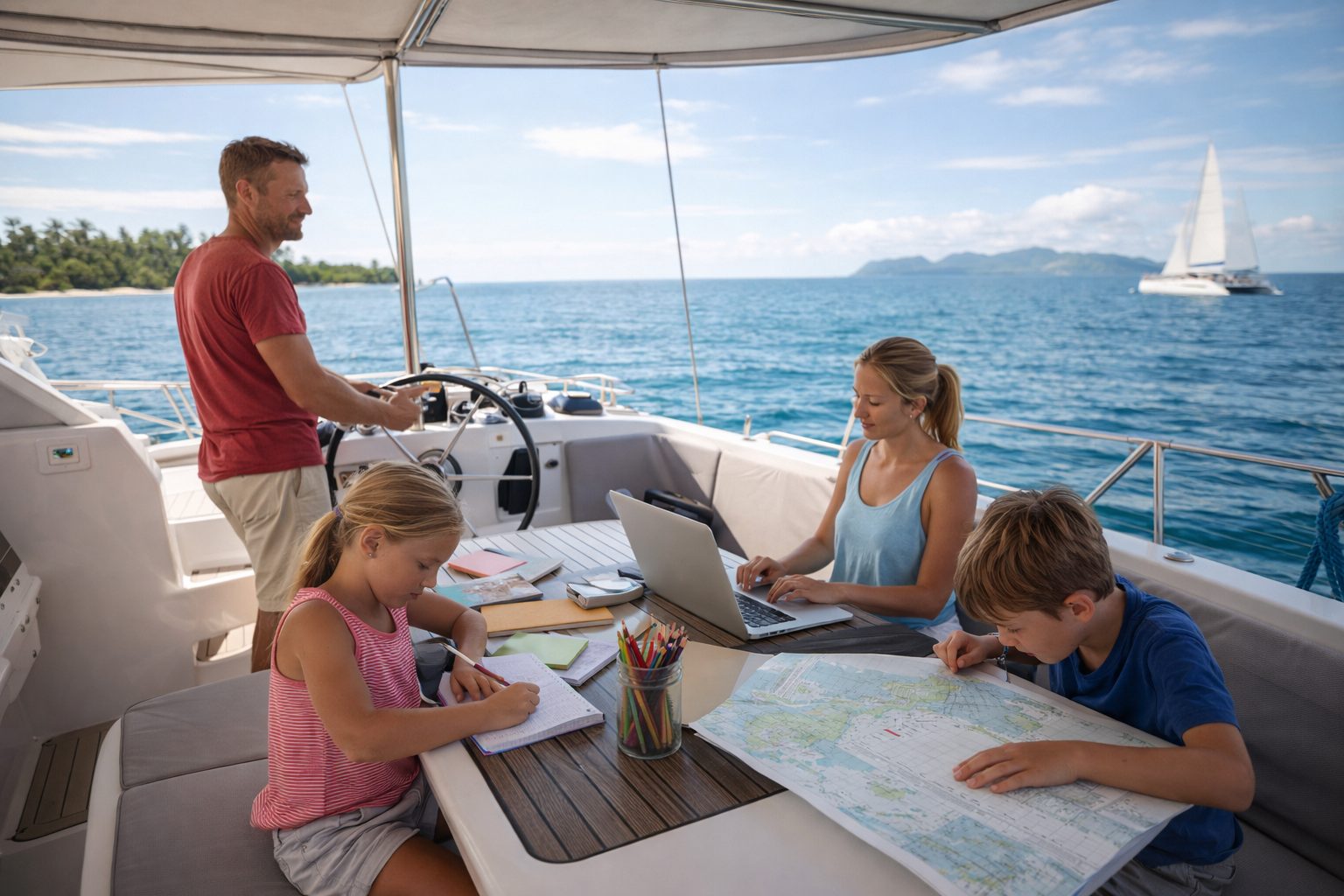
Who this guide is for
This guide is written for a family of four (two adults and two kids) dreaming of 1–3 years of cruising in the Mediterranean with the option to join an Atlantic rally like the ARC later. It is not about racing catamarans or purely charter-focused investment boats, but about a safe, comfortable, and practical floating home for real family life. You will find help here if you want enough space for schoolwork, remote work, and downtime, without losing sight of budget and manageability.
Step 1 – Define your cruising plan before you shop
Weekend sailor, seasonal cruiser, or full liveaboard?
Before you look at listings, be brutally honest about how you will actually use the boat. A family that can only cruise during school holidays has very different needs from one planning to live aboard full‑time for several years. Occasional use puts a premium on easy handling, low maintenance, and access to marinas and services, while full liveaboard life demands serious storage, tankage, redundancy in critical systems, and better all‑weather protection. The more time you spend aboard, the more you will value boring but essential things like ventilation, shade, ergonomics, and good sleeping cabins.
Med now, Atlantic maybe later – design for the “upgrade path”
Many families start with the Med and only later decide if an ocean crossing is realistic. It makes sense to choose a catamaran that is already structurally and conceptually capable of bluewater, even if you do not fit every piece of ocean gear from day one. Think in terms of an upgrade path: a hull and rig that can safely handle trade‑wind conditions, with space and capacity for more solar, batteries, a watermaker, and downwind sails later. This way your first season can be about learning and enjoying the Med, while you gradually add equipment as your skills, confidence, and plans evolve.
Step 2 – Choosing the right size and layout for a family
40–45 ft vs 45–50 ft for a family of four
For a family of four, most buyers end up in one of two bands: 40–45 feet or 45–50 feet. A 40–45 ft cat is the budget‑friendlier entry point, with lower purchase cost, smaller marina fees, and often easier handling for a couple; it will still feel huge compared to a monohull. A 45–50 ft cat brings noticeably more interior volume, load‑carrying ability, and comfort at anchor, which matters once you add toys, school books, tools, and spares, but it will cost more everywhere: purchase, berthing, sails, and maintenance. A useful thought experiment is to imagine a rainy week at anchor with everyone stuck aboard: if that thought feels cramped in the smaller size, you probably belong in the larger band.
Owner’s version vs charter layout
Catamarans are often sold in two main interior layouts: a three‑cabin “owner’s version” and a four‑cabin charter‑oriented layout. In an owner’s version, one hull is mostly dedicated to the parents with a larger cabin, more storage, and often a bigger bathroom, while the kids share cabins in the other hull; this is ideal if at least one adult needs a quiet workspace or you expect to live aboard long‑term. Four‑cabin layouts put two cabins in each hull and work well if you plan to host guests, bring grandparents, or occasionally charter the boat out to offset costs.
Kid‑friendly and parent‑friendly details
Beyond the brochure layout, family life is shaped by small but crucial design details. Look for:
- Safe, well‑protected access between cockpit and saloon with no awkward steps.
- Cockpits that are shaded and easy to close off.
- Good visibility from the helm into the cockpit and forward so you can supervise.
- Solid handholds along all the main routes on deck.
- A gentle swim ladder and easy dinghy access for kids.
- A proper nav station or desk where you can work or manage homeschool.
Step 3 – New vs used catamaran for a family budget
When a new boat makes sense
A new catamaran is expensive, but for some families it’s still the right choice. If you rely on financing, value a full warranty, or need specific layout or accessibility solutions, a new build can provide a predictable, low‑friction start with fewer unknowns in the first years. The downside is that you still need to budget time and money for commissioning, fixing early‑life issues, and adding cruising gear that the yard does not include as standard.
Smart buying in the 5–12 year‑old used market
Most long‑term cruising families gravitate to quality catamarans that are around 5–12 years old. At this age, many boats have already done at least one big trip, so you benefit from proven bluewater capability and previously installed upgrades like solar, wind generation, or upgraded batteries. When shopping in this bracket, focus on:
- Complete maintenance records.
- Recent or renewed standing rigging.
- Well‑maintained engines and saildrives.
- Upgrades that match your cruising style.
Understanding total project cost, not just purchase price
The asking price is only the start of the story. It is wise to create a budget for:
- Safety: life rafts, lifejackets, EPIRB.
- Sails: downwind options, replacements.
- Energy: solar, batteries, alternator upgrades.
- Comfort: canvas work, upholstery.
- Compliance: registration, taxes, inspections.
Step 4 – Safety, seaworthiness, and comfort for kids
What makes a catamaran “bluewater capable” for a family
For bluewater family cruising, you want a structurally robust design from a reputable builder, adequate bridgedeck clearance to reduce slamming, and a sail plan that two adults can manage in rough conditions. A helm that is protected from the elements while still providing good visibility is preferable to an exposed flybridge. Redundancy in steering, pumps, navigation, and power means that a single failure is an inconvenience, not a crisis.
Safety upgrades every family should plan
Even a well‑designed boat benefits from family‑specific safety upgrades. Plan on fitting jacklines, properly placed attachment points for tethers, and child‑sized lifejackets. Establish simple rules like:
“No going forward alone at sea, no cockpit without a lifejacket underway, and one hand for yourself, one for the boat.”
Step 5 – Running costs and the reality of family cruising
Marina fees, maintenance, and insurance
The beam of a multihull means you often pay for a wider berth, and busy marinas in high season charge premium rates. On top of mooring and storage, there are annual or biannual haul‑outs, antifouling, servicing engines and generators, replacing running rigging and sails over time, and insurance tailored to your cruising region.
Energy, water, and living “off‑grid”
A family of four uses more electricity and water than a couple. Investing in a robust energy system—solar panels, adequate battery capacity, and efficient charging sources—pays back by letting you anchor more and use marinas mainly when you choose. A watermaker transforms life aboard by decoupling you from dock water, making small luxuries like a washing machine or regular hot showers realistic even away from shore.
Step 6 – A simple step‑by‑step buying roadmap
From dream to short list
To turn a vague dream into something actionable, start by fixing three numbers: your total project budget, your target size range, and your minimum must‑have features. Research specific models that fit those constraints and narrow to a short list of three to five designs. Use owner groups and blogs to learn what real families like and dislike about each model.
Viewing, survey, and sea trial
When you start visiting boats, go with a written checklist. Walk the deck and inspect structure, windows, and hatches for leaks, then look carefully at bilges, bulkheads, and chainplates. Engage a qualified surveyor to perform a thorough pre‑purchase survey, ideally including a haul‑out and a sea trial where you can feel how the boat behaves in waves.
Planning your first season with kids
Treat your first season as a shakedown year for both boat and crew. Start with shorter hops in settled weather, build routines for watches, school, and chores, and practice emergency drills. By the time you are considering an Atlantic rally, you will have a much clearer sense of your family’s rhythm aboard and whether an ocean crossing feels like the natural next step.
Thinking about buying a family catamaran?
Talk to a specialist who understands real family cruising, not just brochures. We’re happy to help you shortlist the right boats and avoid expensive mistakes.