
(Fair warning - this one's a long read.)
I can't emphasise this enough. As a broker myself, I obviously want people to buy a multihull from me - but what I really want is for my customers to sail off into the sunset and have many happy adventures with their family aboard their new catamaran, and live happily ever after.
Buying your catamaran should be a pleasurable experience, and nine times out of ten it will be. Just don't be the one in ten.
So here's the one thing I always say: ALWAYS HAVE A PRE-PURCHASE SURVEY. Let me say that again - ALWAYS HAVE A PRE-PURCHASE SURVEY.
And it should be carried out by someone qualified, endorsed and accredited by a proper organisation, who carries liability insurance. If they're not, you have no comeback if you later find something the surveyor missed in their report.
The Fox Guarding the Chicken House
Understandably, whether you're buying through a broker or in a private sale, you want a surveyor who's acting for you and in your best interests. Any professional surveyor is unlikely to be doing the broker - or the seller, for that matter - any favours; it would cost him far more than it's worth in reputation.
Sure, the broker and surveyor often liaise with each other to arrange times, dates, the travel lift and so on, and you'll often find they know each other well, even become friends, since they keep running into one another in the same region. But neither the surveyor nor the broker is going to risk tarnishing his reputation for the other.
I've also noticed that many buyers prefer a surveyor who's one of their own countrymen and speaks their language. That's perfectly fine - feel free to bring in your own favourite surveyor, or work from a recommendation.
Who Pays for What: The Buyer's Responsibilities
As the buyer, you're responsible for:
- The cost of lifting the boat out and back in via the travel lift or crane
- The surveyor's fees, travel and accommodation
- The survey report itself, plus any rig check or engine oil analysis
- A licensed, insured professional skipper (if required) for the sea trial, or to move the vessel to a suitable spot for lift-out
All of this typically sits alongside a deposit held in escrow, or in the broker's client account, backed by a signed Sale & Purchase Agreement taken "subject to survey" (and possibly a sea trial). The deposit is taken as security for the buyer, but the yard, surveyor and skipper costs are covered separately by the buyer, and paid before the survey takes place.
These costs are payable whether or not the sale goes through. That's because if the sale falls through, the seller wants his boat back in the water and back where it was stored, in the same condition it left in - and he doesn't want to be left holding the bill for getting it there.
One more thing: we always recommend that an owner never lets a potential buyer stay aboard before handover, for liability reasons.
What the Surveyor Is Responsible For
The surveyor's job is to produce a professional report on the multihull's current condition, on the buyer's behalf. That means checking seaworthiness and overall condition, recommending any remedial work, taking moisture readings, testing for hull strength and delamination, and confirming whether the safety equipment is in date. It also means checking that the engines, generator and all systems are actually operational.
What a surveyor won't do - not without the seller's specific permission - is scrape the hull, disassemble parts, or remove internal permanent panels. What he will do is take all the photos and video needed for the report.
A good surveyor works from a comprehensive checklist, covering things like:
- Engine oil leaks
- Electronic navigation
- Sails
- Skin fittings
- Deck leaks
- Impact damage, fender damage, dents, scrapes, osmosis, delamination and blisters
- Sail drive seals, covers, corrosion and propellers
- Rudder assembly and bushes
- Stanchions
- Nets (making sure they're not rotten)
- Escape hatches
- Moisture readings
Some surveyors also offer an engine oil analysis, sending a sample off to a lab to check for metal particles. Personally, I see little value in it beyond "change the oil" - unless there's heavy blue or white smoke coming from the exhaust, in which case it's worth digging further.
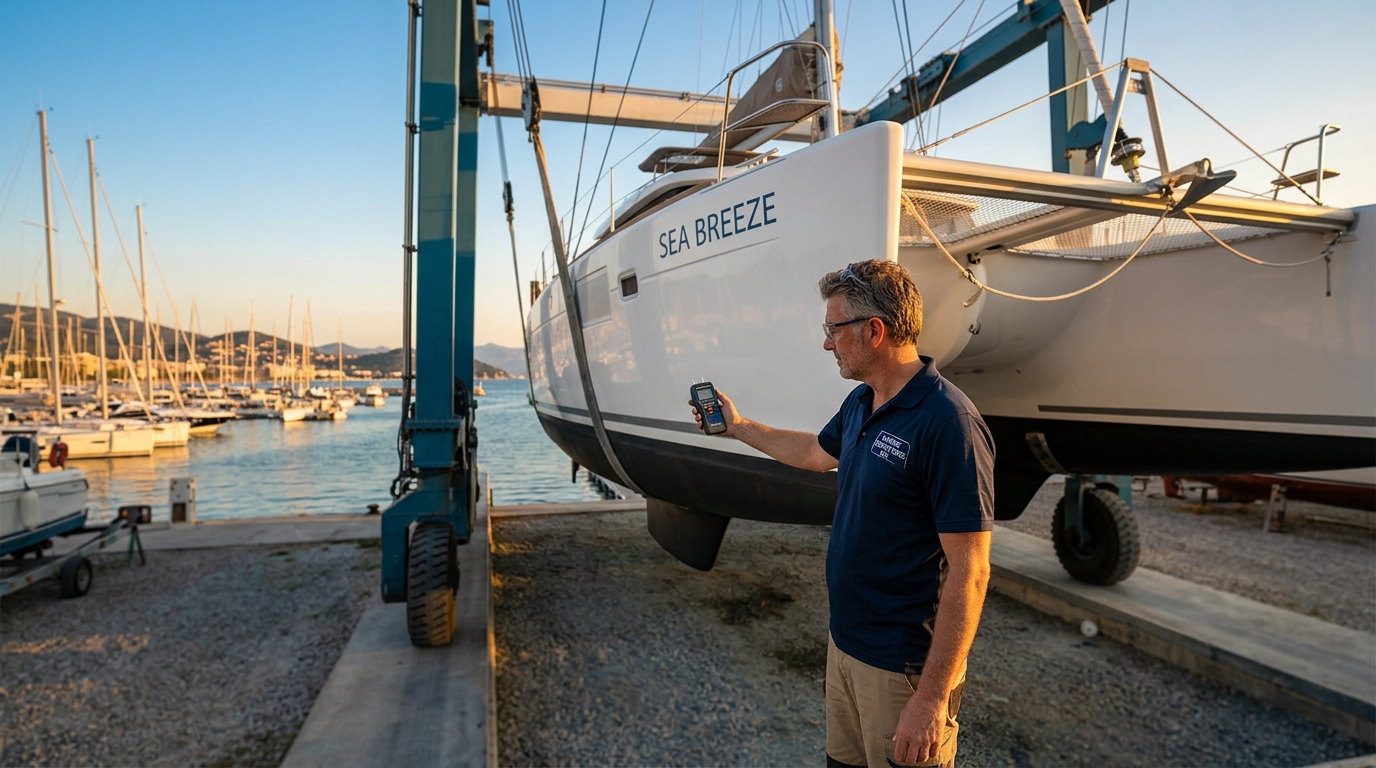
Normally, a surveyor will want the catamaran lifted and left to dry out on the hard for at least three days before he can take accurate moisture readings. That puts real pressure on the buyer, who's paying for the hard standing the whole time the boat's out of the water for survey - and who probably doesn't want to cover the surveyor's accommodation for that long, or doesn't have the time to hang around waiting.
What the Broker Is Responsible For
The broker's job is to make sure all the ship's papers are in order: confirming the vessel's tax-paid status, checking the ship's register for liens or debts, and confirming that any joint owners agree to the sale (if the vessel is owned by a company, different paperwork applies). The broker also liaises with the surveyor, the yard, the buyer and the seller to keep the whole transaction and handover running smoothly.
Any changes, at any stage, need to be signed by all parties as a rectified agreement - if it's not on the paperwork and agreed by everyone, it's not contractual.
The broker also checks that marina fees are paid up to date, and will sometimes sign an undertaking that any overdue fees will be settled on the seller's behalf, once the sale goes through.
What the Seller Is Responsible For
The seller's job is to make sure the boat is clean, tidy and ready for survey, and accessible for the travel lift or crane. That means the engines are in working order, the batteries are charged, and the marina or key holders have given the broker and surveyor full permission and access to carry out the survey and sea trial.
The seller should hand over copies of all the ship's papers to the broker before the survey, and hand over the original ship's papers to the broker, marine documentation specialist or lawyer before completion.
Choosing the Right Surveyor
Bear in mind that in many parts of the world, anyone who can carry a briefcase and buy a Tramex moisture meter can set themselves up as a surveyor. Some "associations" will happily call him one too - pin a Lion Tamer's badge on his shirt, hand him a chair and a whip, and shove him in the cage to get eaten.
Beware of the surveying associations that will take anyone as a member, as long as the cheque clears - let's call them the A.D.B.I. (Association of Dodgy Boat Inspectors). Some countries only require a tick-box survey, confirming the vessel is seaworthy to that country's standard, which may not be a high bar. A properly accredited surveyor, by contrast, should belong to one of the recognised professional bodies - the YDSA (Yacht Designers and Surveyors Association), IIMS (International Institute of Marine Surveying), or SAMS (Society of Accredited Marine Surveyors) are the main ones to look for. Always ask for a proper pre-purchase survey.
Make sure any surveyor you're considering has a website, is accredited to a genuine professional organisation like the ones above, and can show you an example report - so you know upfront whether it'll meet your expectations.
Insurance matters just as much as accreditation. A properly set-up surveyor should carry Professional Indemnity insurance covering at least the value of the vessel plus 20% (to cover legal fees if it ever comes to that), and Public Liability insurance of at least £5 million - which is roughly the minimum most marinas and boatyards require before they'll even let a surveyor onto the premises. Don't be shy about asking to see the certificates.
If he's a little more expensive than our friend from the A.D.B.I., or your mate who "knows a bit about boats," it's worth digging a little deeper in your pockets for the peace of mind. Most proper surveyors are also qualified to run a sea trial and hold a professional licence.
A good surveyor is worth his weight in gold.
The Sea Trial
Weather permitting, a sea trial is always a good idea, and it's nice to be there for it - though not always essential. Don't expect the written report itself until the surveyor gets back to his office, but he can usually give you a rough yay-or-nay on the dock, in private, along with a general idea of his findings.
A sea trial isn't a pleasure cruise. Leave the wife and kids at home - it exists solely to test the engines under load, check the sails, and confirm everything works properly on various points of sail, with the helm and rudders responding as they should. Sometimes weather conditions simply won't allow a sea trial, and that's down to the owner's, surveyor's or broker's discretion.
When a sea trial isn't possible, the broker can offer a retention from the deposit to cover potential repairs - though most well-known, established brands publish polar performance charts, and "it doesn't sail as well as I thought it would" isn't grounds for rejecting the boat on its own.
Delivery Acceptance: What's Fair and What's Not
This is often a form the broker will ask you to sign, and in fairness, subject to major issues, that's reasonable enough. Small gelcoat repairs and stress cracks are common on any previously owned boat, and you can only push a seller so far.
I had a sale fall through once because the buyer insisted the owner replace the burned plastic knobs on the Eno cooker. The owner had already given plenty of ground, and decided this particular buyer was pushing him too far - enough was enough. The buyer had already spent over €3,000 on the lift-out, the surveyor and flights, then pulled out of the sale entirely. The owner flat-out refused to negotiate with that buyer again - and we ended up selling the catamaran for €20,000 more to someone else.
Your survey should be treated as education, not as leverage or a weapon. Plenty of sellers have priced the boat for its current condition - sold "as is, where is," within reason - so some of a surveyor's findings might be just as much of a surprise to the seller as they are to you.
Take the surveyor's recommendations, conclusions and remedy list on board, but be fair, and remember the seller's goodwill is worth having when you're taking over his pride and joy. Boat owners take it personally sometimes - you can probably get away with insulting his mother before you insult his boat. Ha!
Make Sure Your Surveyor Knows Catamarans
This one's really important: pick a surveyor who actually knows multihulls.
I once had a surveyor inspecting a catamaran for an American buyer in Spain - the buyer insisted on an American surveyor, which was no problem at all. At his request, we had the Fountaine Pajot Bahia 46 lifted and dried out on the hard for a week, which was fair enough. When he arrived, water was still "bleeding" from the top of the keels, and moisture readings were high. Fountaine Pajot fit sacrificial keels to all their catamarans: if the boat hits a submerged object, the keel pops out of its casing rather than damaging the hull. The keels are bonded in with a specific, numbered Sikaflex adhesive designed to release on impact, and there's a void above the keel where water gets in and slowly drains away - it does no harm to the hull.
The surveyor didn't want to hear any of it, and insisted the keels be removed, cleaned and glassed back in with epoxy. It took me a week in August to track down someone at the factory who could send proof and reassure the surveyor that this was exactly how the boat was built. That Bahia sat on the hard standing for seventeen days, at the buyer's expense.
Another UK surveyor once declared a catamaran had delamination - while hammer-tapping around the bulkheads, which isn't how you'd normally check for it. Another insisted the rudder bushes were worn, even though they'd recently been replaced within the yard's tolerances; we changed them again anyway, and they came out identical to the ones we'd just fitted. On that note: a good surveyor is one you'd trust with the moisture meter the moment the boat's still dripping in the slings, not just once it's had days to dry out - the difference is in knowing how to allow for it, not in refusing to look until conditions are perfect.
To be fair, some of this caution is earned. Lagoon did have a real issue with bulkheads delaminating on certain models, and any surveyor who knows catamarans will check for it as a priority. Fountaine Pajot had early problems with osmosis and delamination from their infusion process too. A good surveyor investigates these known quirks by brand, and talks to the manufacturer if needed.
But if your surveyor tells you the boat's a shed and to walk away - take his advice. He knows you're excited, that you've fallen in love with the boat, and that you've spent a small fortune in expense and travel to get there. But remember: he's working for you, not for your feelings.
Rig Checks, Chartering and Tonnage Measurement
Rig checks are rarely done by the surveyor himself - that's a job for a reputable, qualified rigger. Insurance companies are increasingly insisting that standing rigging be replaced within ten years; some will accept a rig check instead, but that's rare, and it isn't cheap either way.
If you're planning to charter the catamaran, you may need to register the vessel in its intended charter destination - the rules vary a lot by region. You might also need a tonnage measurement, which requires the boat to be out of the water anyway, so it's often worth doing at the same time as the survey, provided the boat's in good shape.
New Catamarans Under Warranty: The Snag List
Some buyers also have a new yacht surveyed before handover, which is understandable. Plenty of modern production catamarans are put together by assembly workers, not boat builders - they might as well be assembling washing machines.
I've seen a client's anchor and chain disappear on the very first night at anchor, because whoever fitted it never tied on a bitter end. I've seen stress cracks you could put your hand through, galley cupboards falling off the bulkhead, a Corian sink cracked clean in half, and a boom that parted company with the mast in 35 knots of wind because the gooseneck wasn't bolted on properly. I've seen the steering gear come apart on a lee shore, reefing lines that were never attached before sailing out of harbour into a blow at night, gelcoat that hadn't cured properly, and a compass that had never been calibrated. I've seen an engine exhaust fitted too low, hydro-locking the engines mid-Atlantic, bilge pumps that didn't work, and air conditioning that tripped the generator the moment it reached working temperature. The list goes on.
One builder hit the top of a brand-new catamaran on the factory doors, then tried to bodge the repair by filling the gap with two inches of Sikaflex. I could go on - and this wasn't just one builder. I could tell you some stories. And yes, they still want full payment before you leave the shipyard. Don't believe me? I've got plenty of written evidence.
I know this all sounds a little negative. It isn't meant to put you off - just get the process right, do it properly, and you'll be fine. That's exactly why I'd recommend having a surveyor check out a new boat before handover too. Everything above happened to a new boat, on delivery or on its first trip out of the marina - and not to just one owner.
Fair winds,
Graham Stimson
Need a surveyor?
Check out our list of marine surveyors who know multihulls, on our services page.Marine Surveyors →