
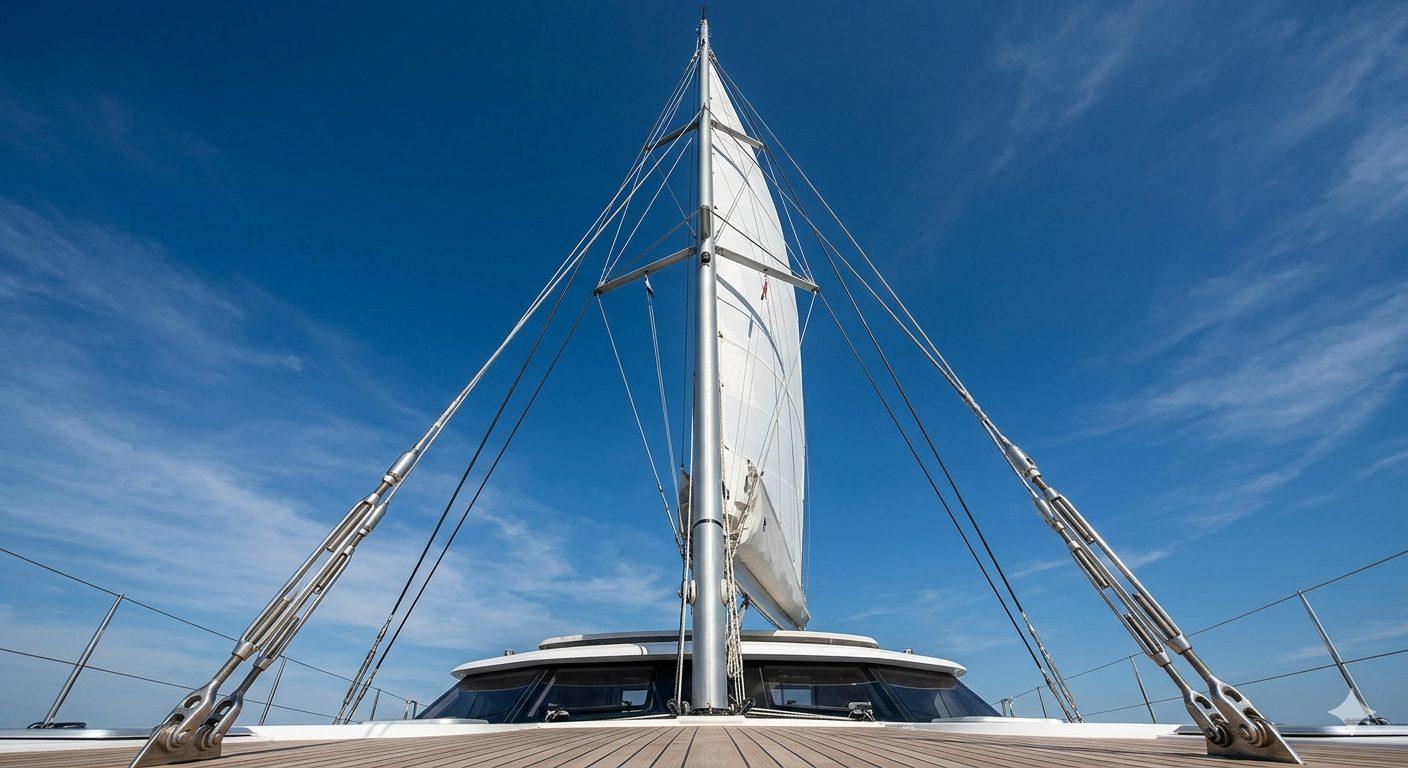
OK, stupid question I know, but those wires are holding your mast up - that’s what those wires are for!
The standing rigging is one of the most important things to keep an eye on on your catamaran. Those big white flappy things (the sails) employ a huge amount of strain pushing your catamaran forwards at a fairly rapid pace.
The forces involved on your poor mast and standing rigging are incredible, and all that force that’s driving you forward into a head sea in heavy weather, reefed or not. Sometimes your bows are going to bury themselves deep into a big wave, bringing your catamaran to an immediate halt, while your mast is still driving forward. The whole of that stress is relying on your standing rigging!
Insurance and Requirements
Nowadays, the marine insurance companies are clamping down, stating that it’s obligatory to have your rigging replaced every 10 years, which in a way is understandable.
I personally am no fan of marine insurance companies as, when it’s time to pay up, they do try in most cases to wriggle out of paying out. BUT this time, I hate to admit it, they are right!
Very few will accept a RIG CHECK by a qualified rigging company. They check the mast, swages, chainplates, crosstrees, seagull striker, crossbeam - everything.
Types of Rigging and Potential Failures
You have stainless steel solid rigging, stainless steel wire rigging, carbon fibre, Dyneema rigging - it all needs attention. Wire rigging, the most common, has strands of wire that can get damaged, twisted, and can also corrode from the inside out. Corrosion or broken strands can be practically invisible on your catamaran high up the mast. Bottlescrews can rust from the inside, again invisible.
A catastrophic rig failure at sea in heavy weather can be extremely dangerous and kill people, not just be a terrifying experience and do massive damage to your lovely catamaran!
With a rig check done properly, the rigger will X-ray or ultrasound the rig, take photos of any problem areas, but this inspection is sometimes quite expensive and money spent could have gone towards complete replacement! Any marine surveyor on a pre-purchase survey does not normally include inspecting the standing rigging as it is a specialist’s job - a rigger’s…
Costs and Considerations
Roughly, it will cost you about $10K to replace the rigging on a 40ft catamaran. The bigger the mast, the bigger the expense. Sometimes, if inspected, you may get away with just having to partially replace it.
I have had a few boat sales go through where the seller will do anything they can to get out of paying for a full standing rigging replacement. Sure, it depends on what work the boat has done, heavy weather it has endured, area of sailing, etc., but the seller may say:
- It was replaced two years ago (it wasn’t)
- The rig was checked by a rigger and it was OK (it wasn’t)
- The catamaran has only had light use, popping over to Ibiza and back from the mainland, meandering through the islands in the Caribbean (it wasn’t)
GET PROOF with a detailed, dated invoice from the rigging company or your insurance company will not accept a “pinky promise” that it was done by the owner when your mast parts company with your boat halfway across the pond!
Please, if you are buying any catamaran on brokerage, TAKE THIS INTO ACCOUNT!
Also check that the rig is tensioned correctly or it will add extra force by “whipping” your shrouds if they are too loose.
If you have had your catamaran for many years, please at least get a rig check. But you know yourself how old your rig is, and you could be on borrowed time, Charlie Brown!