
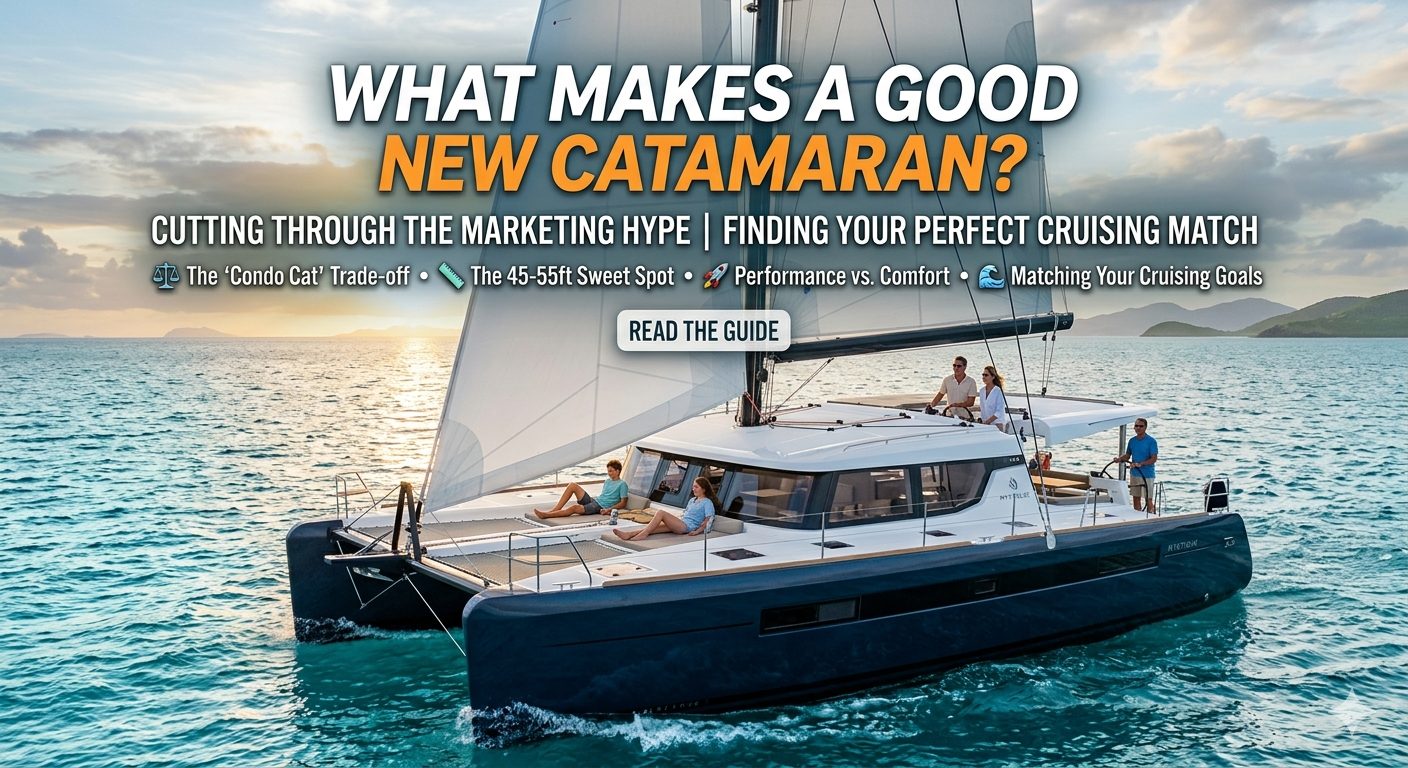
If you’re looking for not just a good catamaran, but a great catamaran for cruising with your family, how do you cut through the massive maze of marketing hype, glossy brochures, and boat show sales pitches?
It’s not always easy.
Back in the early days, catamaran design was much simpler. In some cases, the beam (that’s width for the beginners!) was determined by something as simple as the size of the shipyard doors. Some builders still face similar limitations today.
Likewise, certain hull shapes are not always designed for maximum performance, safety, or comfort. Sometimes they’re designed to allow the hull to come out of the mould more quickly so the builder can start the next boat and improve production efficiency.
Every builder has their own sales pitch and a handful of unique selling points they want you to focus on.
The truth is that every catamaran serves a purpose.
The Rise of the “Condo Cat”
Take modern charter catamarans, for example.
These boats are designed primarily for charter operations in places like the British Virgin Islands, Bahamas, Balearics, Greek Islands, and other cruising grounds where most passages are relatively short and often within sight of land.
Their job is simple - carry lots of people in comfort.
As a result, they come loaded with equipment:
- 4-5 cabins
- Multiple refrigerators
- Generators
- Washing machines
- Large flybridges
- Hard biminis
- Dive platforms
- Davits and cranes
- Heavy jet tenders
The list goes on.
Most have helm stations located high on a flybridge, which pushes the boom higher and raises the centre of gravity.
They offer fantastic living space, but there are trade-offs.
Higher freeboard and bridge deck clearance create more windage. In a marina, a strong crosswind can push you sideways almost as fast as your sails move you forward.
That said, the major builders must be doing something right - some are producing more than 600 catamarans per year.
Weight Is The Enemy
One of the biggest performance killers on any catamaran is weight.
The more equipment, toys, generators, air-conditioning units, and tenders you add, the heavier the boat becomes.
Catamarans are famous for being unsinkable, but enough weight in the wrong place can change the characteristics of any boat dramatically.
Every kilogram matters.
So What Makes A Good Catamaran?
These days you can ask ChatGPT what the best catamaran is and you’ll get an answer.
But remember an old computer saying:
G.I.G.O. - Garbage In, Garbage Out.
The reality is much simpler.
A good catamaran is one that gets you safely on the water, suits your lifestyle, and allows you and your family to enjoy sailing.
Everything else is a compromise between comfort, performance, and budget.
Build Quality Around The World
Catamarans are now built all over the world:
- France
- Germany
- Holland
- Italy
- Poland
- Latvia
- Thailand
- Vietnam
- South Africa
- China
- United Kingdom
Build quality continues to improve globally, and labour costs vary dramatically between countries.
Sometimes you’ll find a better-built catamaran at a lower price simply because labour costs are lower in that region.
The world is a much smaller place than it used to be, and it often pays to look beyond the traditional production builders.
What Size Catamaran Should You Buy?
The answer depends largely on your budget and intended use.
I’ve seen couples successfully sail 80-foot-plus catamarans without crew thanks to electric winches, furling sails, and modern systems.
Personally?
For owner-operated cruising, I’d suggest: 50-60 feet maximum.
Beyond that, costs rise significantly:
- Marina fees
- Maintenance
- Haul-outs
- Insurance
- Repairs
For a husband, wife, and small family living aboard permanently, I believe a 45-55ft catamaran is the sweet spot.
Performance vs Comfort
Every buyer eventually faces the same question:
Do you want performance, comfort, or maximum space?
You rarely get all three.
Performance catamarans typically feature:
- Narrow hulls
- Lightweight construction
- Daggerboards
- Folding propellers
- Carbon fibre structures
- Carbon rigs and booms
- Lightweight sails
- Dyneema rigging
- Twin helm positions
All of these reduce drag and improve sailing performance.
Carbon construction can significantly reduce weight while increasing strength.
One well-known naval architect once told me the weight difference between an aluminium mast and a carbon mast can be equivalent to parking a Range Rover on top of your mast.
That gives you some idea of the forces involved.
Then there are foils.
I’ve been told a 60-foot catamaran sailing at 20 knots could gain roughly 2 additional knots through foil-assisted drag reduction alone.
Speed comes at a price, however. Just like high-performance sports cars, faster boats tend to be more expensive, more complex, and require more attention.
What Would I Choose?
If I were buying a catamaran for myself and my family today, I’d probably choose:
- Around 55ft
- Owner’s version with three cabins
- Twin diesel engines
- Shaft drives for simplicity
- Folding propellers
- Galley-up layout
- Easy engine access from outside the accommodation spaces
- One electric head and two manual heads
Simple, practical, reliable. The sort of boat that allows you to spend more time cruising and less time fixing things.
Final Thoughts
Before buying any catamaran, ask yourself one question:
What kind of sailing am I actually going to do?
- Coastal cruising?
- Ocean crossings?
- Liveaboard life?
- Charter use?
- Performance sailing?
The answer will guide every other decision.
There is no perfect catamaran. Only the catamaran that’s perfect for you.
Choose carefully, ignore the marketing hype, and remember:
We cannot demand anything from the sea. But we can demand everything from our catamarans.
Kind Regards,
Graham 🙂