
Who is going to buy them?
Power Catamarans have been growing in popularity for so many good reasons, have you noticed how many commercial applications have been turning to catamarans hulls, most big fast ferries are now noticeably converting to catamarans powered by powerful MTU engines crossing huge distances between islands, even local harbour taxis and inland waterways shuttling passengers with the benefits of low wake and stability.
Many fishing trawlers have converted to catamaran hulls and even the military has joined us with obvious stability factors of stealth, advantages and low wake. Work boats and cranes mounted on cat hulls have obvious reach and weight lifting advantages.
When you think of it with the traditional heavy displacement monohull is like pushing a brick through the water using one or two huge engines guzzling gallons of expensive fuel, no wonder 90% of boats stay put, more often in the marina.
In the marina near where I live in Spain we have 45 -50 ft monohulls cranking up their twin 500hp engines blast over to the other side of the bay for the day and back that probably cost at least 350 Euro and it's only about 5 miles and that's all they do!
I remember when I was younger before I ever got involved with boats one of my wealthy friends in the UK purchased a Princess 50ft + motor yacht. The boat was moored in the Hamble in the UK and I was invited to go on the pre Christmas Booze Cruise to Cherbourg we had to divide the running cost between 6 of us which cost us 780 GBP then in fuel alone which was expensive then, now it would probably cost about 1,500 quid each way!
The sea state did not help, but progress then was only about 6 knots to give any degree of comfort.
Not only that with the swell and the rock and roll we were all chucking up to all points of the compass, I swore I would never set foot on a boat again, ha!
Later on in life I notice that very rarely I see many of these big motor yachts cruising over 19 knots even on a flat sea, they may be more than capable of 20knots plus, but rarely use that powerful either reasons of fuel economy or sea state.
When bringing a small Fountaine Pajot Greenland Trawler Yacht from Zeebrugge in Belgium to Portsmouth harbour in preparation for Southampton boat show.
We were being followed by a big Sunseeker who because of the sea state in a short steep chop was being thrown all over the show and it turned around and went back, we kept trucking along at a reasonable 8 knots.
After playing with a few motor yachts in the past I noticed another fact just in time. At the lock gates at Port Solent I had to throttle back in a panic as a conventional hull will kind of stop as the hull sinks on the waterline, but a catamaran will keep going as there is so much less resistance.
Less Resistance = smaller engines = lighter = better fuel economy = longer range! at the very least 20%, but mostly 40% or more efficient with some brands even claiming 50% better fuel economy!
When power catamarans started to emerge on the market they were not that exciting to look at, mainly chunky looking Trawler types, which don't get me wrong, many loved, but just didn't attract the pointy, sleek looking motor yacht buyers. Now they are starting to attract a different kind of buyer…… Power catamarans are starting to look sexy!
With offerings from builders like Blue Coast Yachts, Latitude Yachts, Sunreef on the supercat end of the scale, Fountaine Pajot, Lagoon, Bali are all attacking the power cat market. Being more manoeuvrable spacious and stable.
We like to keep our builders close to home here in Latvia, where Dan Levy at ‘O’ Yachts is now building a range of power catamarans and knowing Dan, he will be building something special!
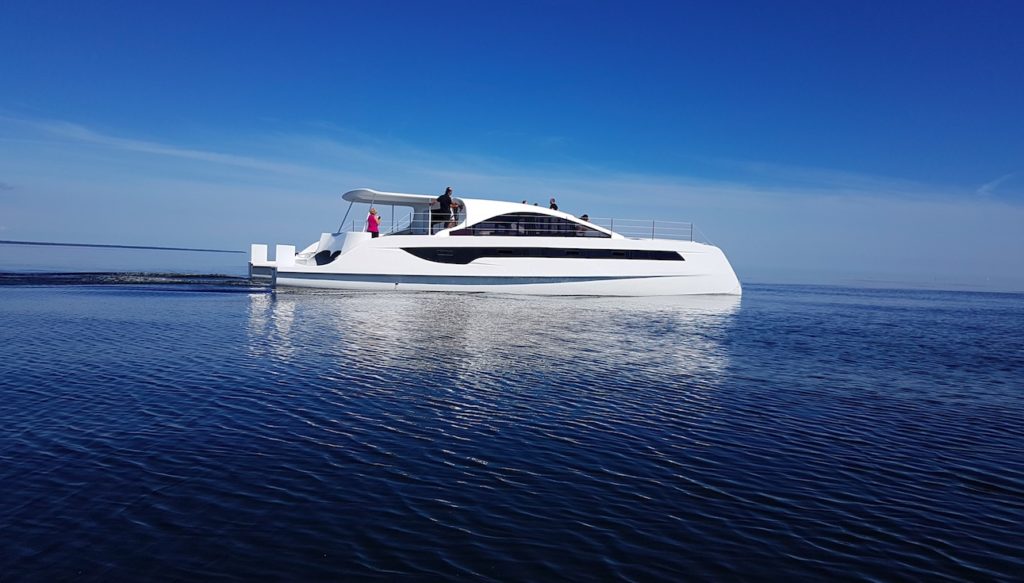
Power catamarans just seem to be so much more purposeful for long distance cruisers in the way of economy, space, manoeuvrability and stability achieving a much greater range. Especially in this day and age of escalating marine diesel prices.
They are also so much more manoeuvrable with the twin engines spread further apart, which make things even easier in the marina especially with the aid of a bow thruster.
Twin 600hp engines would be a typical requirement on a 50ft monohull that on a catamaran of the same length would only require twin 350hp to drive it along at a reasonable turn of speed….
Some power cats are quoting 1000 nautical mile ranges now on a tank of fuel, with plenty of space for extra tankage especially with a water maker or some flexi tanks the Atlantic Crossing is now a reality for a cruising power cat.
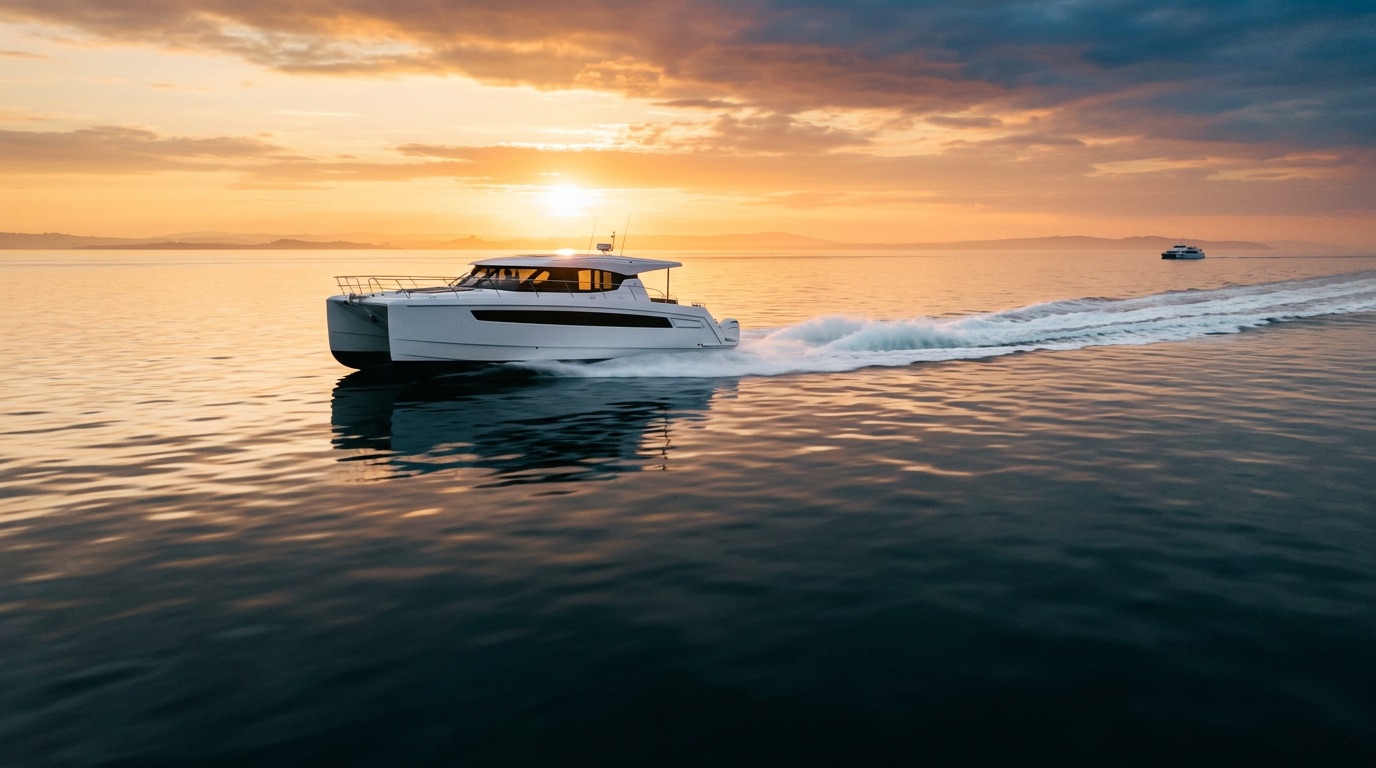
Many older sailors already discovered the benefits of catamarans who have got to the stage they are not so fit as they once were can still enjoy those benefits in the form of a motor cat without much compromise and no bits of string to pull!
Also I have seen a few owners now that just leave their mast in storage strip their rigging off and use their sailing catamaran as a power cat!
They do not travel at more than 8 knots+ anyway. They love their cat, they can troll along at 6 knots and catch fish, the boat is more stable, WHY NOT?
Related reading
- Catamarans vs Monohulls – An Honest, Experience-Based Perspective
- Catamarans vs Trimarans – Which Multihull Is Right for You?
- The Ultimate Catamaran or Trimaran?
- Choosing The Right Tender
- Buying a Family Catamaran in 2026: From Med Dreams to Atlantic Crossing
See power catamarans →
Graham, Worldwide Catamarans